logo
좋은 가격 온라인으로

제품 세부 정보

Created with Pixso. Created with Pixso. 상품 Created with Pixso.
고철 포장기 기계
Created with Pixso. Y81T-315 Scrap Metal Baler for High-Density Bale Output

Y81T-315 Scrap Metal Baler for High-Density Bale Output

브랜드 이름: HUAKE
모델 번호: Y81t-315
MOQ: 1세트
가격: USD15000-USD 35000
배달 시간: 30일
지불 조건: 신용장, 전신환
상세 정보
원래 장소:
중국
인증:
CE
모델 번호.:
Y81t-315
HS코드:
84629190
포트:
중국 상하이
인증:
CE SGS
힘:
수력 전력
자동등급:
PLC 자동 제어, 원격 콘 롤
적합:
스크랩 구리, 알루미늄, 강철, ubc 캔 등
작동 압력:
25MPa
기원:
중국
판매 후 서비스 제공:
24시간 온라인 서비스
이름:
스크랩 구리 baler.scrap 구리 압축기, 구리 베일링 프레스, 구리 프레스 기계
포장 세부 사항:
가치 있는 패키지, 방수 기능을 수출하세요.
공급 능력:
연간 200pc
제품 설명


Product Overview

The Y81T-315 hydraulic scrap metal baler is positioned as a machine for turning loose scrap into dense, regular bales that are easier to stack, handle, and transport. The most useful specification for this angle is the listed bale density of not less than 2000 kg/m³, supported by a defined chamber size and bale size format.

Instead of describing output with broad language, the PDF gives a measurable bale density, a fixed bale cross-section, and a stated cycle time and throughput figure for steel scrap. That makes this version well suited for buyers focused on loading efficiency and downstream handling.

Applications

This page version is suitable for scrap yards, transfer stations, and recycling operations where the main requirement is not only compression force, but also a bale format that supports easier storage and transport. The machine’s stated ≥2000 kg/m³ density and (600–1000) × 600 × 600 mm bale size are the most relevant data for this use case.

The specification sheet gives production data for steel scrap, so steel scrap remains the most direct application supported in the document.

Core Advantages

Dense bale output

The machine is listed with a bale density of not less than 2000 kg/m³, which is the central technical value for this page version.

Defined bale format

The bale size is specified as (600–1000) × 600 × 600 mm, allowing buyers to understand the output shape and size range in practical terms.

Chamber capacity for loose scrap

The 3000 × 2000 × 1200 mm compression chamber supports batch compression of loose scrap before bale formation.

Compression force behind density

The dense bale output is supported by a 3150 kN main cylinder, 1600 kN × 2 side pressure cylinders, and a 1250 kN cover door cylinder. This is important because density claims should be tied to force structure, not left unsupported.

How It Works

Loose steel scrap is loaded into the chamber, where hydraulic cylinders compress the material into a denser mass. The chamber size, cylinder force layout, and bale dimensions together determine the final bale structure. Once the bale reaches the required form, it is discharged through the side push-out method.

The process is supported by PLC automatic control with remote controller, which helps maintain more standardized operating steps during bale formation and discharge.

Specifications

  • Compression chamber: 3000 × 2000 × 1200 mm
  • Bale size: (600–1000) × 600 × 600 mm
  • Bale density: ≥2000 kg/m³
  • Main cylinder thrust: 3150 kN
  • Side cylinder thrust: 1600 kN × 2
  • Cover door cylinder thrust: 1250 kN
  • Cycle time: about 130 seconds
  • Steel scrap throughput: about 6–10 tons/hour
  • Total power: 74 kW
  • Pump pressure: 31.5 MPa
  • Oil tank: 3500 L
  • Control system: PLC automatic control with remote controller
  • Discharge method: Side push-out

How To Choose

Choose this machine when bale compactness, loading efficiency, and defined bale dimensions are key purchasing factors. The first figures to compare are the ≥2000 kg/m³ bale density, the chamber size, and the bale dimensions.

If your operation is mainly concerned with reducing loose scrap volume before transport, the density and bale format data may be more useful than tonnage alone. If your main priority is maximum compression class, another page angle may be better.

What Problem It Solves

Loose scrap is difficult to stack, inefficient to load, and expensive to move when it remains uncompressed. This machine solves that problem by forming denser and more regular bales with a specified density of not less than 2000 kg/m³ and a controlled bale size range.

It also helps buyers evaluate logistics value through measurable output data instead of relying on unverified phrases like “compact transport solution.”

FAQ

What bale density is listed in the PDF?

The bale density is listed as not less than 2000 kg/m³.

What is the bale size?

The bale size is (600–1000) × 600 × 600 mm.

What is the chamber size?

The chamber size is 3000 × 2000 × 1200 mm.

What material is the throughput data based on?

The stated throughput of about 6–10 tons/hour is given for steel scrap.

How are the bales discharged?

The machine uses side push-out bale discharge.

  •  

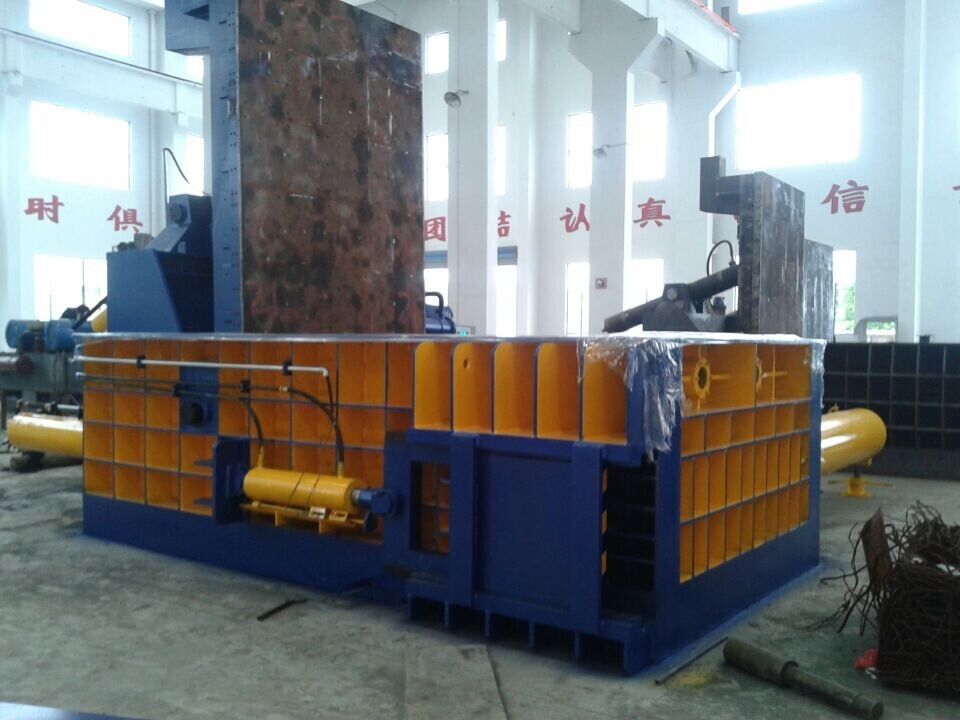
machine pictures
Y81T-315 Scrap Metal Baler for High-Density Bale Output 0
Y81T-315 Scrap Metal Baler for High-Density Bale Output 1


bale pictures:


Y81T-315 Scrap Metal Baler for High-Density Bale Output 2
 How to choose your baler correctly?

We will ask you to offer some details

Like what material you need to bale. Pictures best,

How many tons per hour output is needed.

And bale size restrictions

Bale ejection ways preference.

Other machines on sites .etc

Then we will give a most suitable solution for you.

we will also offer similar user sites vedio for your reference, maybe in your same country we have users also.


Watch The Video:


Youtube: https://www.youtube.com/watch?v=QHD1xZvVTQY